
While Oʻahu’s South Shore is famous for its sunny skies, warm temperatures and beautiful beach weather, it is still a tropical environment—and that means rain is part of the package from time to time. Waikiki and the surrounding South Shore have its own local weather patterns and microclimate, just as other areas of Oʻahu do, so a passing shower can roll through even when much of Honolulu remains warm and inviting. For visitors, an unexpected downpour can sometimes throw a wrench into vacation plans: you probably don’t want to hike Koko Head in a torrential rainstorm, for example, and certain outdoor activities simply aren’t as enjoyable when the weather turns wet. But if you’ve planned ahead and booked (or are considering booking) a surf lesson or surf experience in Honolulu, you may be wondering: can you surf in the rain in Waikiki? You don’t want to go through the hassle of pre-booking a surf lesson only to have precipitation put a damper on what is supposed to be a favorite part of your Hawaii vacation. The good news is that, for the most part, yes, it is perfectly fine to surf in the rain in Waikiki, with mild to moderate tropical rain not generally meaning surf plans need to be cancelled. The article below explains what you should know about surfing in rainy conditions in Waikiki.
What to Know About Booking a Surf Lesson / Experience on a Rainy Day in Waikiki Beach, Honolulu
Is it Safe to Surf in the Rain?
For the most part, a mild to moderate rain does not mean you need to abandon your plans to surf Waikiki Beach, but the same cannot necessarily be said for every surf spot around Oʻahu. Many of the island’s popular beginner- and intermediate-friendly breaks are located near stream mouths, drainage channels or other points where rainfall runoff can make its way into the ocean. After significant rain, that runoff can carry bacteria, sediment and other contaminants from inland areas into nearshore waters, which is why the Hawaiʻi Department of Health advises avoiding ocean water near stream mouths, drainage outlets and canals, as well as brown or murky water following heavy rainfall. On the North Shore, areas around Haleʻiwa and Puaʻena Point, for example, have recorded elevated Enterococcus levels following major storm events, while West Side beaches can likewise be affected when runoff reaches the coast. Even on the South Shore, there are locations where surfers should exercise particular caution after heavy rain, including Ala Moana Bowls, which sits in the broader runoff influence of the Ala Wai watershed and its canal outlet. The important distinction for visitors is that rain falling on you while you surf is not, by itself, the same thing as contaminated runoff entering the ocean. Waikiki’s Kūhiō Beach, where Sparky’s Surf School is one of the few operators permitted to conduct surf lessons, is situated away from the Ala Wai Canal outlet and has historically shown generally favorable water-quality results even after significant rainfall.
Will My Lesson Be Cancelled if it Rains During My Pre-Booked Time?
You don’t need to worry about Sparky’s Surf School cancelling your pre-booked surf lesson simply because it happens to be raining on your scheduled day. Rain alone generally doesn’t prevent us from getting in the water, and we’ll be there ready to surf with you at your scheduled time. We only cancel when ocean or weather conditions become unsafe, such as excessive winds, strong currents or unusually large swells—conditions that can occasionally, although rarely, accompany significant tropical weather. If we do need to cancel your lesson for safety reasons, we’ll work with you to reschedule for another day or time that works for YOU. And if you don’t have enough time remaining in your Hawaii vacation to reschedule, we’ll provide a full refund. Otherwise, simply show up at your scheduled day and time, and we’ll take care of the rest—including storing your belongings in a safe, dry and secure location while we paddle out together and enjoy the waves!
Can I Cancel My Lesson if I Don’t Want to Surf in the Rain?
Yes. While a passing shower or light sprinkle is generally no reason to cancel your surf lesson, we understand that conditions can occasionally be different. If excessive, heavy rain sets in and continues rather than simply passing through as tropical showers often do, you will be given the option to cancel your lesson and either reschedule for another day or time that works for you or receive a full refund if you are unable to reschedule before your Hawaii vacation comes to an end. Our goal is to make sure you have an enjoyable experience without feeling stuck with a surf lesson when unusually severe rainfall has made the conditions less appealing.
Is it Fun to Surf in the Rain?
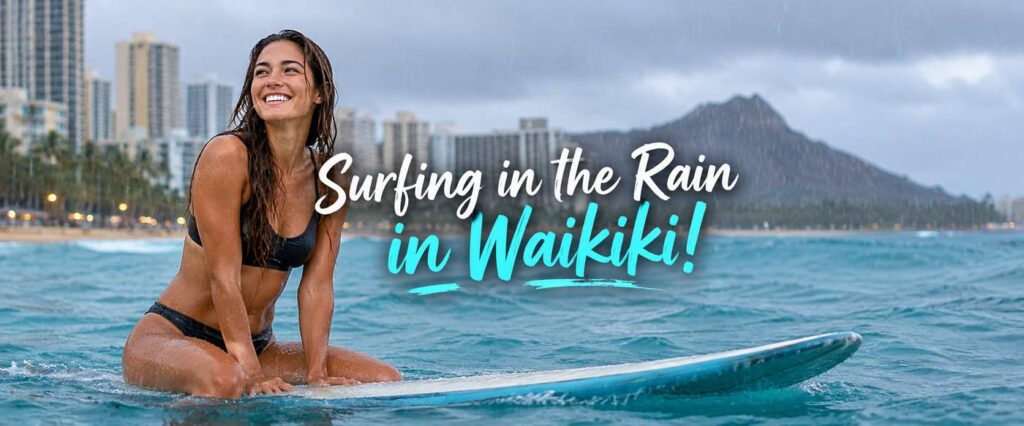
In Waikiki Beach, a mild or moderate tropical shower can actually make a surf lesson even more memorable. Rather than letting a little precipitation rain on your parade (literally), embrace it as part of the Hawaiian experience—once you’re already in the warm Pacific, getting wet from above really doesn’t make much difference! There can even be some unexpected advantages to enjoying your surf experience while it’s raining:
- Warm water and warm air: Waikiki’s tropical temperatures mean you’re unlikely to feel cold during a typical rain shower. It often feels warmer to be in the water than walking on land when it rains here in Honolulu.
- Fewer people on the beach and in the surf zones: A passing or lingering shower sends most beachgoers looking for cover, giving you a little more breathing room. It also sends fair-weather surfers to the land as well, leaving more waves for YOU to ride!
- The adventure factor: A little rain can turn an ordinary surf lesson into a story you’ll be telling friends and family back home. Surfing while tropical rain falls around you is something you will remember fondly long after your vacation.
- Beautiful tropical scenery: Rain can create dramatic skies, changing light and occasional rainbows around Diamond Head and the Waikiki coastline.
View additional FAQ right here.
BOOK A WAIKIKI BEACH SURF LESSON
(rain or shine!)